
you ain't god, diva
the third decan of taurus

A small note before I begin. I am likely to slow down my article output here on Substack for the next week or so. But I post daily on Instagram and Threads (@nattystrology), so check me out there if you would like more up-to-the-minute takes on things. But as this post shows, I’m not quite holding myself to the kind of restraint required of me to not publish. Mars in Aries wants me to follow where my passions take me, and that means posting compulsively and that fallen Saturn in Aries is weak to stop it!

As of Sunday, May 10 at 11:50 am EDT, the Sun is in the third decan of Taurus, where it will be until Wednesday, May 20 at 10:37 pm.
This decan is ruled by Saturn in both Chaldean and triplicity schemes. It corresponds to the 7 of Pentacles in tarot.
Austin Coppock calls this decan “A String of Prayer Beads,” T. Susan Chang calls it “Fail Better,” Nicola Allan calls it “Weather the Storm,” and Kira Ryberg calls it “The Waiting Game.”
If we start the zodiac with Aries, this is the first decan to be ruled by Saturn in either the Chaldean or triplicity scheme. It’s the first decan since Aries I and II to double up on the same planet in both schemes. It’s also a uniquely malefic space in a sign that is otherwise very benefic and life-giving, with Taurus being the domicile of Venus and the exaltation of the Moon. Not only is it ruled by the greater malefic in both schemes, it contains mostly the bounds of Saturn and Mars. This decan is also home to the fixed star Algol, the head of Medusa, at 26° Taurus, itself a pretty ferocious star.
Over at the Astrologers' Co-Op , Joey Cannizzaro writes,
The degrees 20-30 Taurus… have malefic rulership by bounds: only the first 2 degrees are ruled by Jupiter, followed by 5 degrees ruled by Saturn, and the final 3 by Mars. I noticed that even the dodecatemoria of Taurus III are only signs from the winter solstice to the spring equinox [Capricorn through Aries], making the final decan a little microcosm of the coldest, darkest part of the year, somehow right in the middle of the new life and warmth of spring.

This is interesting to me because the triplicity ruler assigned to Taurus III is Saturn due to its rulership over Capricorn, the sign corresponding to the winter solstice. Capricorn season is the time of year we weather the cold and dark, where we simply endure, where we delay gratification and move at a measured pace. While Taurus is a Spring sign, the image in the Waite-Smith tarot is of someone with a gardening tool waiting, perhaps for fruit to ripen, perhaps anxiously hoping that the elements are kind and don’t destroy his crops.
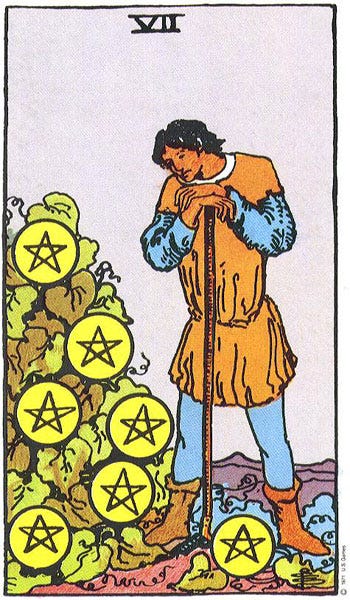
Over on Patreon, Dr. Jess mentions Saturn’s role as agricultural deity, describing the 7 of Pentacles as “a card that focuses on steadiness, perseverance, patience, and planning. It’s also associated with harvest, which aligns with T. Susan Chang’s connection of Saturn with its earth god essence, such that he acts as a god of agriculture and fertility — but also endings and destruction.”

This is a decan of being prepared for disaster, taking out insurance, but also recognizing that we don’t have total control over things going right or wrong, that sometimes when things go wrong or when we act hubristically, we have to petition for grace and assistance.
As Jess notes, “The Seven of Pentacles isn’t a simple effort = positive outcome journey.” We can account for as many variables as possible and prepare accordingly, but ultimately, we’re not God and there’s a point at which we have to surrender control, because with total control comes hubris.
You ain’t God, diva.
In 36 Faces, Austin Coppock writes,
While in the first decan of Taurus great plans were laid and in the second, success was obtained, the third represents a confrontation with destructive factors which impede completion.
Saturn’s rulership over this decan makes me think about how Saturn can represent frustration, in addition to discipline: we can do our best to be prudent, but we will hit roadblocks and bad things will happen in spite of our best efforts. Sometimes we fail.
In her guidebook on the decans, Kira Ryberg writes,
The spirits that are said to rule over this decan are the Litai, also known as the personified spirits of prayer. They were called the ‘ministers’ or sometimes ‘daughters’ of Zeus, and were responsible for bringing healing and repair after damage had been done.
Joey notes that the name of the Litai is usually translated as “prayers,” but in Richard Lattimore’s translation of The Iliad, the word supplication is used to describe the prayers of the Litai. “Supplication” Joey writes, “is the act of surrendering your pride completely and begging for mercy.”
Again on Patreon, Jess writes,
In this [decan], a hard lesson is taught: the security the fixed earth of Taurus seeks cannot be attained through force, control, or power. You cannot strong-arm your way through the sensory challenges of this decan. Seeking support, confronting the hardships through cultivating resilience, and submitting to the stories of this decan with detached curiosity are some ways Taurus III can be confronted with a layer of perceived control.
On Substack, Chloe Margherita writes about the fixed star Algol, which is located in this decan:
Algol, the head of Medusa, has a universally malevolent reputation that makes many stay away or disregard its nuance. Its fearsomeness should not be ignored; the figure upon which the asterism is based is a snake-headed gorgon who can turn men to stone— on top of the deep pain and anger she has within her. The Hebrews called her ‘Rosh ha Satan, Satan’s Head.’ The Chinese called it ‘Tseih She, the Piled-up Corpses.’ But Ovid also points out that Medusa was ‘famed for her beauty,’ as well as represented an ‘older, priestess-type of wisdom’ that angered the more male-centered, logical order of the Greeks. She is thus known for her pulchritude as well as her deep connection to the knowledge of the enchanted earth.

About Medusa, Joey writes,
In Ovid’s telling, Medusa is herself a living revenge against the patriarchy. Before becoming a monster, she was a beautiful, mortal woman who was raped by Neptune in Minerva’s temple. Instead of blaming the rapist god, Minerva punished Medusa, transforming her into a horrifying gorgon who turned anyone who looked at her into stone (a very Saturnian superpower). Her punishment may have been sickeningly unjust, but it made her a supernatural force of obliteration.
Jess continues,
Taurus III houses Algol, a fixed star associated with the head of Medusa, which is notoriously framed as one of the most sinister and violent stars in the fixed star realm. As with everything, Algol is not unidimensional — some perspectives acknowledge the deeper patient and spiritual qualities of the star system. Nonetheless, stacking the influence of the Saturnian decan with the malefic fixed star can correspond with this decan magnifying calamities. Both Coppock and Ryberg note the importance of preparation for periods of lack, with Coppock sharing that leading with humility and asking for support (e.g., from spiritual sources or close others) can be a source of profound power.
Finally, Joey writes,
It feels important to resist a conservative, moralistic reading of this decan, as though it punishes you for sinning, and somehow praying to god and feeling guilty is what brings realignment. The horrible things that happen to us are so often… not our fault at all, and not a lesson for us to learn, but experiences for us to draw power from nonetheless, the power that comes from surrender, from abandoning composure…. You defy [the Litai] and call down their vengeance not when you make delusional mistakes, but by clinging to pride and the performance of dignity in the face of collapse.
There’s hubris and there’s humility. There’s calamity and there’s grace.
We can prepare for the worst, but there also comes a time when we need to let go and let God.
This decan has tinges of all of these things.
Ultimately, none of us are God and that’s a core lesson of this decan.
I hope that you check out and support the work of all of these authors, most of whom have platforms where you can join up as a patron. Check out any of the hyperlinks above for information about their work and ways you can support them.
If you would like to support my work financially, consider becoming a paid subscriber.
For now, all my posts are free to everyone, but I will be dropping exclusive content for paid subscribers in the very near future.
In addition to becoming a paid subscriber, you can support my work with a one-time tip at any amount of your choice at the button below.
You can also leave me a tip on Venmo @nattystrology.
Be on the lookout for a more formal system for booking readings with me, but if you would like to inquire about a reading with me in the meantime, reach out to me at nattystrology@gmail.com. I provide a variety of astrology and tarot readings at a sliding scale. I would love to work with you!
Want to make time to listen to this- Medusa is/has been a guide since I was super young. Some of my first dreams that I can recall are with her, she often sent me on Dreamworld quests. And in my dreams, age 6 or so, she was beautiful and I couldn't understand why people thought she was ugly or vengeful- I could look her in the eyes, loved snakes, and all things underground and labyrinthine; I didn't learn about her rape until well into adulthood. This all lives in my psyche as "of course I love the unloved and unappreciated, Medusa is my homegirl" always believing there's more than meets the eye or coming for dominant paradigms sideways; and I'll save my remaining thoughts for when we get together 😉
I was just re-listening to this article and I encourage everyone to read Joey’s article. There’s so much about how *undignified* acts of supplication can be, how grief and morning is unsavory to a buttoned up culture bent on control. In quickly synthesizing all this stuff, there are so many angles and nuances I brush over.
This is making think about how I would probably add some whine emojis to my Taurus III emoji assemblage
😫😩